What’s slimy, slow-moving and silent but an efficient and voracious recycler of the forest fungi and debris? If you guessed a slug, you’re right. We’re lucky to live close to forests that are cleaned and gleaned by enormous banana slugs (they are the 2nd largest land gastropods in the world and can grow up to 20 cm.)
Like waves on the shore, slugs travel on a viscous layer of slime they produce and move by wave-like contractions of their muscular foot. The slime contains a numbing substance to deter predators that might try to munch on the munchers; in the spring and fall you can find slugs curled around or on top of mushrooms as they use their long toothed radula (tongue-like tool) to scrape and tear pieces to digest. You can’t hear them but the speed of destruction is awe-inspiring.
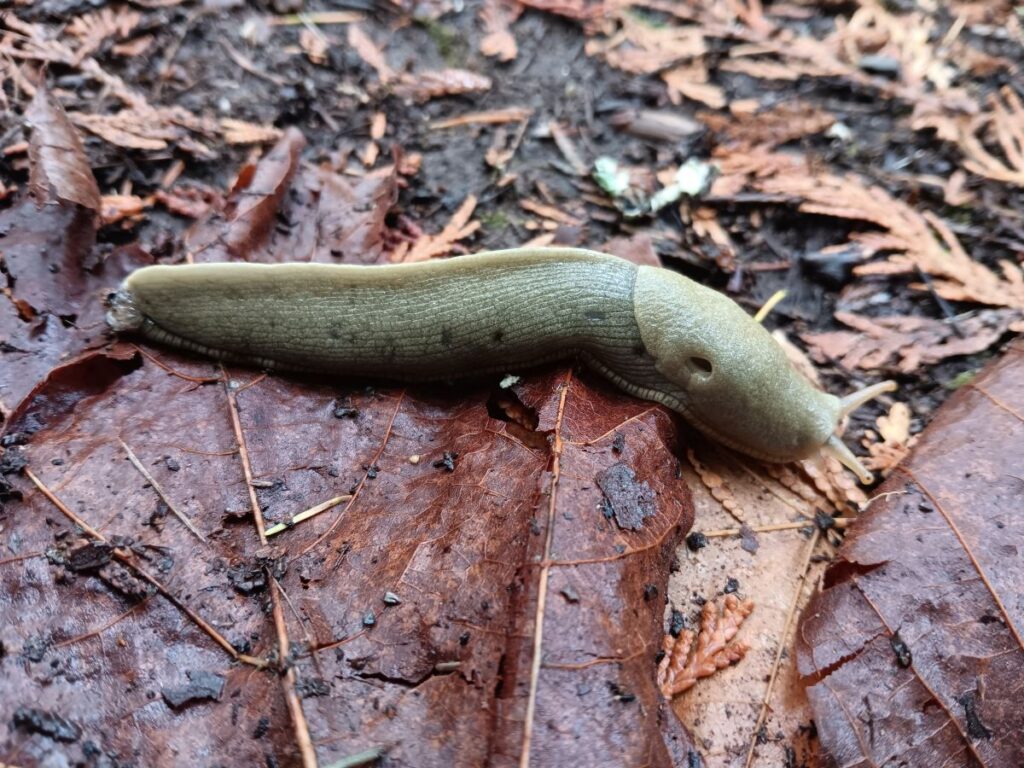
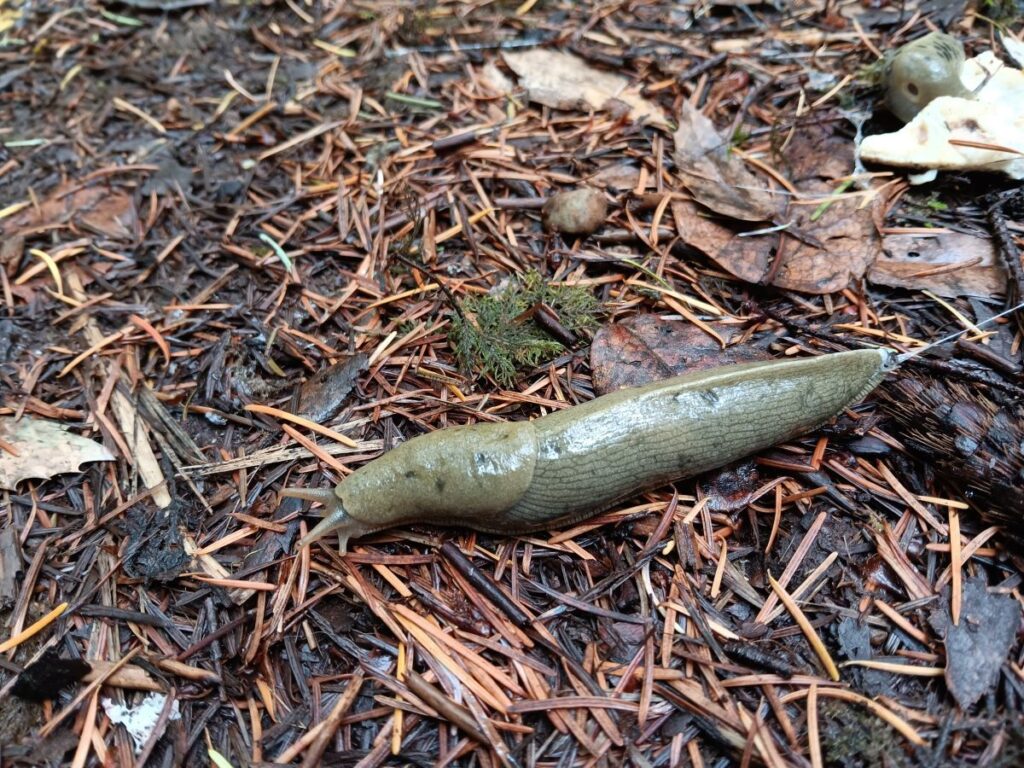
Why “banana” you might wonder as you encounter them in local Vancouver Island forests. Apparently the yellow colour is most often found in very moist old-growth forests. Most of mid-Vancouver Island forests have been logged and replanted so the cover is not as dense or as moist. Most of the slugs we see are a pale green-grey or a pale beige-brown. Some have black spots or patches that make them look leopard-like. No one seems to know why? If you see an all black slug it will likely be an invasive European.
Like other molluscs, slugs have a soft, unsegmented body without a spine (invertebrates). Their bodies are divided into a head and foot, with a mantle protecting the main organs. The head carries four retractable antennae: the top two are for sensing light and shapes (they don’t actually “see” you) and the bottom two antennae are for chemo-sensing as they share messges in slug slime or sense potential food. When food is found, the slug extends an intriguing “tongue” called a radula with many microscopic “teeth” that rasp and tear plant materials.
Banana slugs generally have a a distinct hole (the breathing pore called a pneumostome) on the right side of the mantle, a “skirt” along the bottom or foot and a tail that is often decorated with tree needles and other debris.
You may be intrigued if you ever encounter a mating pair of slugs. What the heck are they doing? Banana slugs are hermaphrodites so they each have male and female reproductive organs, but they tend to seek out another slug (by sniffing the slime trails of others using their two sensitive tentacles on the lower side of the head.) The upper tentacles on the head are light detectors (slugs don’t actually “see” you as a distinct entity). They curl up side to side and exchange sperm. One or both will form small, jelly-like eggs that they lay in rotting logs or other protective cover.
The best information I’ve found so far (if you want to learn and see even more about banana slugs) is the Hinterland Who’s Who (Canadian resource) or the University of Oregon’s extensive site Slug Portal.