On a windy, gloomy and wet March morning in Ucluelet, we gathered our rain gear, ball and a very excited Border collie-Aussie shepherd dog into the car to head up to a dog-friendly beach on the West Coast. We arrived to find few people, lots of sand, wind and rain — a perfect day to chase a ball! Taz could barely contain himself (he’d been here before) and quivered until we took him off leash. As soon as the ball was in the air he became a streak of rusty brown and white.
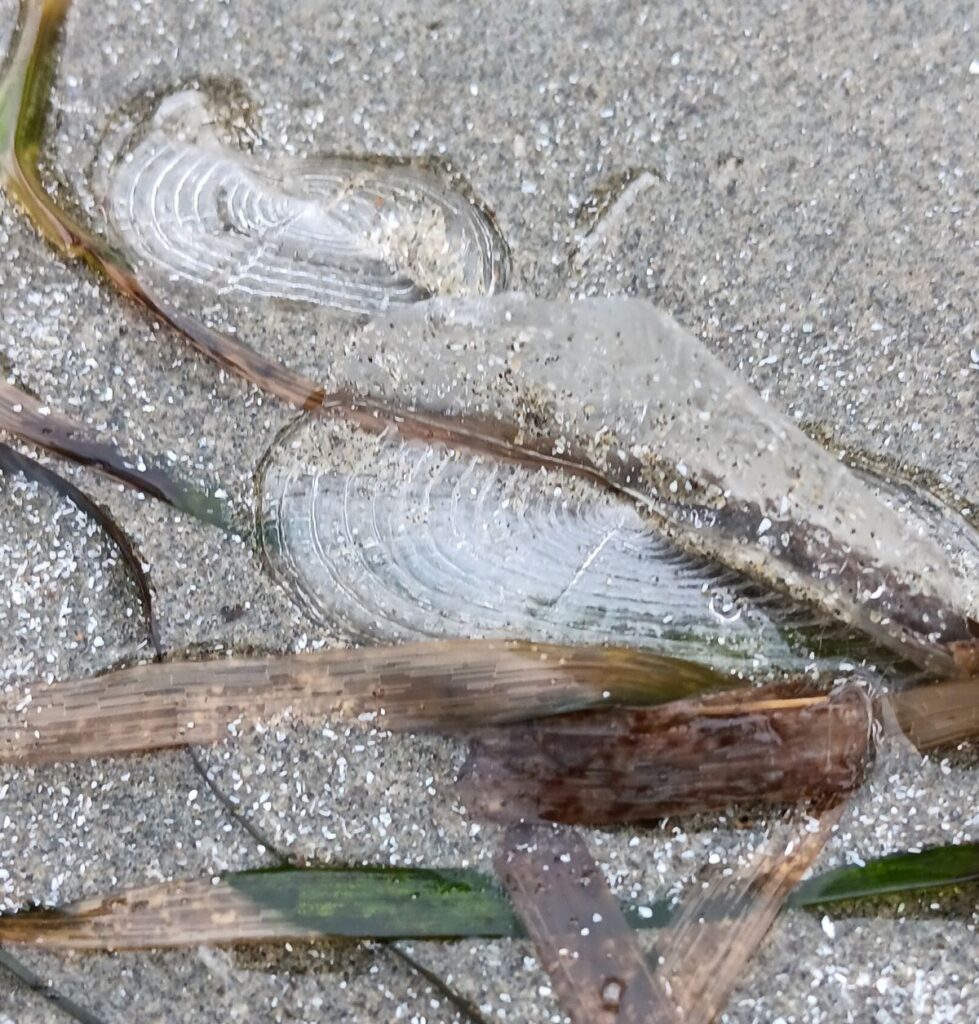
We followed, huddling inside our rain coats, turning our faces away from the wind’s bite. I noticed what looked like small piles of plastic (not that uncommon on West Coast beaches unfortunately. ) I pulled out a waste bag, meaning to collect the garbage; but, as I looked again, I recognized the fractured sails of Velella velella (By-the-wind sailors). Although these crystalline-and-blue invertebrates are seen periodically on beaches on the west side of Vancouver Island and other coastal areas, By-the-wind sailors are intriguing, beautiful creatures that have puzzled scientists for quite a while. Are they sea jellies or a type of colonial hydrozoan comprised of many jelly-like polyps living on the surface, driven by the winds against a rigid, vertical, transparent-translucent sail?
The most current scientific information seems to agree that Velella is a unique genus with only one known member, Velella velella. It is a hydrozoan that lives in the boundary layer between air and the warm and temperature oceans around the world. This makes it a neuston (or a “pleuston”). Its “sail”, an upright rigid elliptical structure made of chitonous material can be either “left-handed” or “right-handed”. If a sail runs north-west to south-east, Velella will drift left of the wind direction. Sails that run south-west to north-east will force Velella to drift right of the wind direction. (Note: This characteristic is known as “chirality”.)
Velella are Cnidarians as they are carnivores of marine zooplankton, which they capture with the downward-hanging tentacles of the polyp(s) that contain stinging cells (nematocysts). In turn, Velella are eaten by specialized molluscs like nudibranchs (sea slugs), purple snails, and occasionally, the ocean sunfish (mola mola).
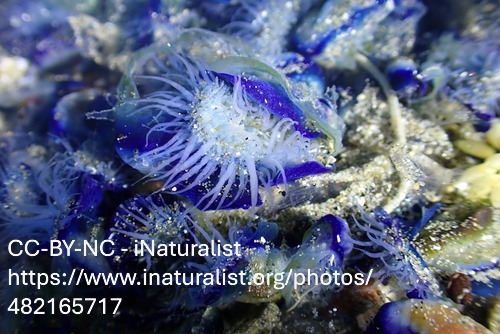
This photo from iNaturalist shows the hydroid’s tentacles and vivid blue colour platform.
Check out images of Velella velella from around the world on this iNaturalist page: https://www.inaturalist.org/taxa/59698-Velella-velella/browse_photos
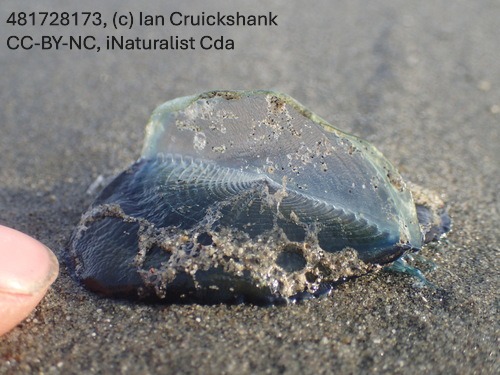
This image from iNaturalist’s Ian Cruickshank, taken in the Alberni-Clayoquot area, shows the dark blue colouring of the platform (the blue indicates the presence of symbiotic algae) and the intricate sail. (see https://www.inaturalist.org/photos/482165717
If you are still intrigued by these unique creatures, take time to watch this video from Monterey Bay Aquarium Research Institute – it explains the life cycle of hydroids and how they believe the Velella evolved to live its life upside down on the surface of the world’s oceans.